


Step 1
Introduce the activity

Use simple, neutral language such as:
“These cards are to help me to understand how school feels to you so that we can make it better for you. There are no right or wrong answers. Some children/ young people agree with lots of these, and some don’t. You just choose what feels true for you.”
Step 4
Select the most important cards

Now lay down the 'The most important one(s) for understanding me' card.
Ask the child to select which cards from the 'True for Me' cards are most important for understanding them. This could just be one card, or several. If they need further prompting, ask questions such as;
"Which ones matter most to you?"
"Which ones impact you most at school?"
"Which ones would you most like your teachers to know".
Follow these simple steps to ensure a meaningful and productive session with the child.
Instructions
Step 2
Sort the cards

Lay down the ‘True for Me’ and ‘Not True for Me’ cards.
Go through each card one at a time, encouraging the child to place it under one of the two categories.
Where possible, try not to introduce a 'sometimes' option as this can make it more difficult to understand needs clearly.
Step 5
Looking Forward

Now use the gentle, solution-focused question card to help the child to consider actions that they feel would help them to feel supported in school, as well as providing a debrief to ensure that the young person feels supported following the activity.

Step 6
Identifying unmet needs

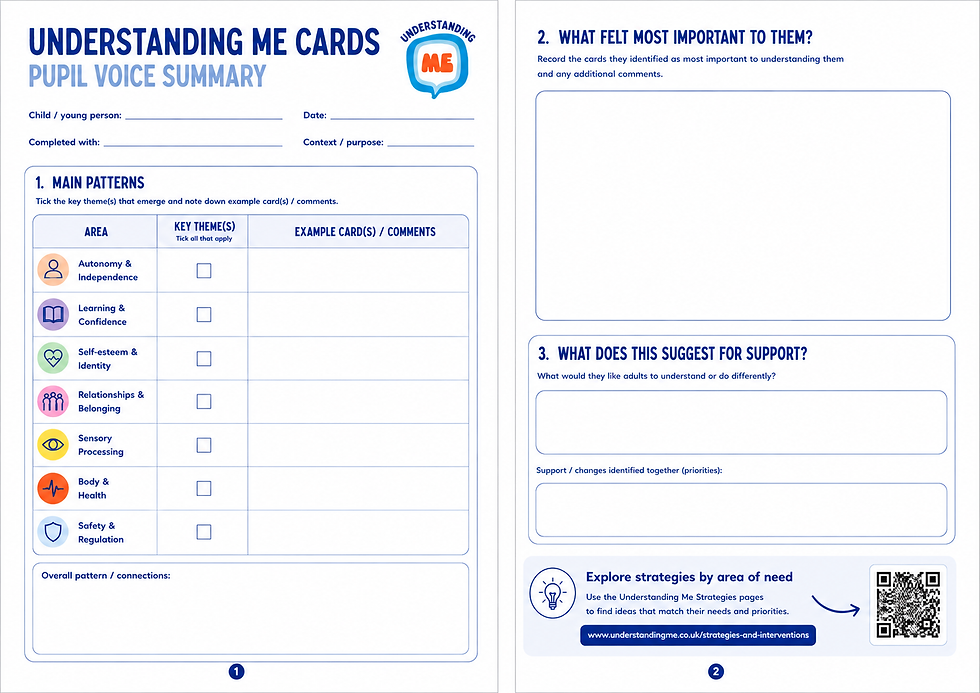
As well as taking note of the individual statements that are most important, look for patterns in the colours of the cards that they have selected as being true for them. This will help you to identify areas in which the child may need adaptations to the environment or further support.
Top Tips
Keep sessions short and manageable for the child's attention span. Some children may be able to do all the cards in one session and for others, you may need to split the activity across multiple sessions.
Read each statement slowly and neutrally, without showing any judgement or opinion.
It might be helpful to provide autonomy by letting the child/ young person move the card themselves.
Read the statements with the child/ young person even if they are capable of reading them independently to ensure they have understood and are giving their answers due consideration. This also opens the cards up for discussion as you go through them.
Show the card to the child/ young person to ensure understanding through the pictures.
Avoid prompting (e.g. “Are you sure?” “I think you sometimes feel this way”) to allow the child or young person to allow space to have their voice heard.
The resource works beautifully when used alongside strengths-based resources to ensure a holistic picture of the child's strengths and needs.
Why is there no 'Sometimes' option?
A “Sometimes” option is not included because it tends to reduce the quality of the information gained from the card‑sort. When given a middle choice, many children and young people default to it to avoid committing to an answer, especially those who are anxious, perfectionistic, unsure what the “right answer” is, or reluctant to reveal something personal. This creates a “safe” middle ground that prevents clear patterns from emerging and can mask important underlying needs. The statements on the cards already contain natural qualifiers such as “sometimes”, “often”, so a third category is not required to capture nuance. Using only “True for Me” and “Not True for Me” encourages pupils to make a meaningful choice and allows staff to see, with much greater clarity, which experiences truly resonate and which do not, leading to more accurate interpretation and better-targeted support.
Safeguarding and ethical considerations

-
If a child agrees with safety-related items (e.g., “I sometimes don't feel safe at school”), follow your school safeguarding procedures.
-
If a child or young person becomes distressed, pause the activity and offer regulation support.
-
Participation should always be voluntary and the child/ young person should be allowed to stop the activity at any time if they don’t feel comfortable.
-
Explain to children/ young people how the information will be used and who it will be shared with.
-
Some of the cards require children to consider their thoughts, feelings and emotions, and whilst this is so important for understanding their needs, it may leave them feeling exposed and emotionally vulnerable. Always ensure there is adequate time for the 'Looking Forward' card. This acts as a solution-focused, debrief conversation that ensures that the activity is left on a hopeful note and that children and young people leave the activity feeling settled and supported.